
BY PAUL BUTLER, SOL PHOTOGRAPHER & DRONE OPERATOR
If you have paid a visit to St. Finian’s medieval church and graveyard, in Esker, Lucan, recently you will have noticed that South Dublin Co. Council have installed handsome handmade railings around the vault area. This is part of the work that SOL have requested as part of the restoration work for the site. Using part of the old piece of railing remaining, they have recreated how the railings would have originally looked, with a gate at the front of the vault. SOL are delighted to have this work done as it greatly enhances the site and complements the rest of the restoration work of the last few years. This work has been done in association with SDCC and the Adopt a Monument scheme which we are involved with, to help protect this part of Lucan’s history for many generations to enjoy in the years ahead.
So as part of the work required, they cleared out the floor area at the front of the vault. This revealed the steps that originally lead into the vault. This is where two new headstones were discovered that we never knew about. Even the previous inventory of gravestones and their transcriptions, made by Fr. Egan in 1989, available from SDCC Source online: https://source.southdublinlibraries.ie/handle/10599/12242 didn’t record these gravestones, as they were only uncovered during these recent works.
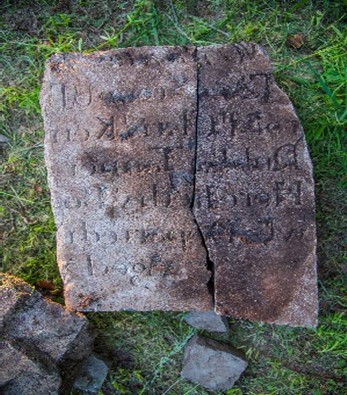
As we always record work in progress on site for future reference, we noticed two pieces of headstone which would have came from under the clay and also large stones SDCC removed from the front of the vault area. The second piece of headstone was used at some point to repair part of the steps leading into the front of the vault and was uncovered when the clay and stones were removed also.

The first two pieces were in with the pile of stones that were removed to allow the work to be conducted on the vault surround. The second piece of this headstone was found near the clay that was removed. We placed the two pieces together which matched up together perfectly! At present we have little information on this headstone only that it belongs to a “Christopher” who worked as a Tanner (tanning leather, presumably) but are continuing to research it, and will update everyone when we have more. If YOU can carry out research into it, please do, and let us know?

The second headstone piece which was used to repair part of the step has a bit more information on it which we investigated and are continuing to investigate. This headstone was uncovered also while clearing out the front of vault area. As you can see in the photo, they were Silk Weavers by trade with the name Kelly. While we investigated this, we are still researching this by using the many resources available like Dublin City Library and Jstor.org and The Irish Guild of Weavers and others to see if we can find out as much information as we can. So, what have we found out so far? Weavers would have arrived in Dublin around the seventeenth century and were French Huguenot and would have been based around the Liberties with many of them silk weavers. We have found A Edmondus Kelly who was a weaver in Dublin around 1660 and an Arthur Kelly 1735 who had an apprentice that serve his time with him called Thomas Kelly 1749 of Francis Street Dublin. You can see by the headstone it has two other names on it belonging to a Margaret and a James Kelly and the date is from around 1776-79. While we have much more research to do on this headstone and try to connect the people buried there but it is a start, and we can work on from there.

While it is always exciting to find new headstones in St. Finian’s it makes you wonder how many more are buried around the site or were used in the repair of the church or parts of the site that we do not know about and have yet to discover and give us a greater insight to the people who are buried in the graveyard. Some of the existing gravestones are of guildsmen / tradesmen from Dublin city and their families, especially in the 18th century.
As part of our research and to help us with reading the inscription on the headstone we use a method called photogrammetry which can also help with hard to read headstones. This also produces a 3D image of the headstone piece which can be used to analyse the headstone and if needed to send it on to experts for advice. This method requires taking a series of photos of the headstone and uploading them into a photogrammetry program to produce the 3D image. This method can be used by anyone who have a device that can take photos and some easy-to-use free software if you would like to try it to make a 3d image. For the examples you see I have used a more advanced type of paid software. I have used this method on the two new pieces of headstones that have been uncovered so we have a 3d image for reference and to see I it showed up any missing details.

by Paul Butler, SOL
Leave a Reply