
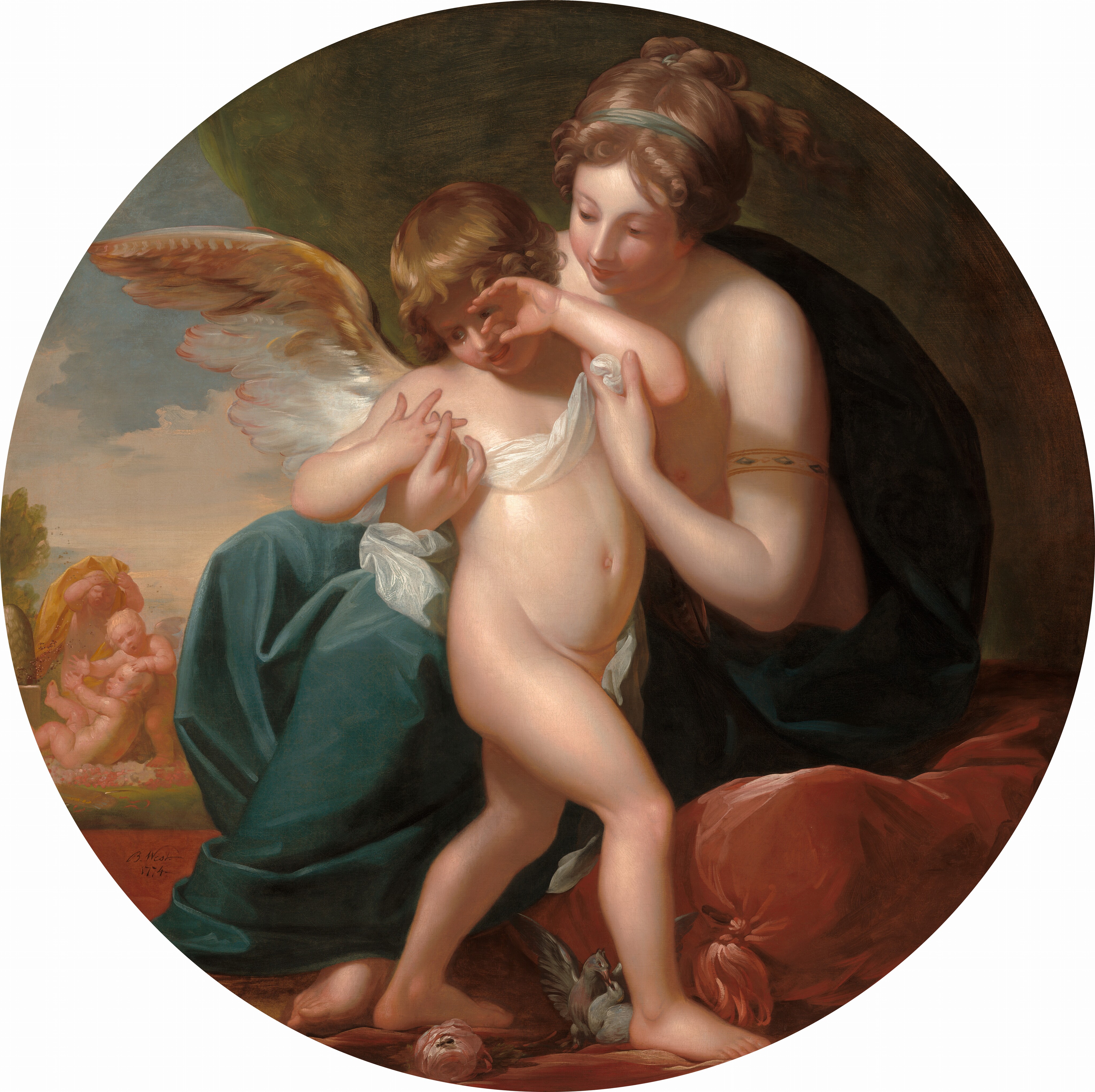
As Cupid midst the roses played, Transporting in the damask shade, A bee stepped unseen among The silken leaves’ his finger stung. His beauteous cheeks with tears were drowned; He stormed, he blew the burning wound, Then nimbly running through the grove Thus plaintive to the Queen of Love: “I’m killed, Mamma; alas, I die! A little serpent winged to fly That’s called the bee in yonder plain, Has stung me, and I die with pain.” When Venus smiling thus rejoining: “My dear, if you such anguish find From the resentment of a bee, Think what they feel that’s stung by thee.”
Theocritus 19th Idyll.
(Source: Cupid and the Bee, Cambridge University Press)
Much is lost when a great House is sold. Its contents become scattered to the wind, and any architectural features that are not structural become salvage. Lucan House was no exception, however detailed provenance for some of Lucan House’s original artwork exists.
The catalogue from the sale of the contents of Lucan House in September 1925 listed a myriad of items, few of them insignificant, from decortive urns that once adorned the entrance foyer to numerous family portaits; the accumulation of verious generations of Veseys.
The oil painting, “Cupid, Stung by a Bee, Is Cherished by his mother”, by American artist Benjamin West, was commissioned by Agmondisham Vesey (the Younger) of Lucan House in 1774. Cupid, having been stung by a bee while stealing honey, is shown seeking the comfort of his mother, Venus.

Cupid, Stung by a Bee, Is Cherished by his Mother, 1774, Benjamin West. Source: National Gallery of Art Washington.
The painting was listed for sale as Lot 105 in the auction of the contents of Lucan House in September 1925. It was later sold at auction in London on 3rd December 1926, and has since come into the ownership of The National Gallery of Art, Washington.
Unfortunately, the fable of Cupid’s sting appears to have been lost on Agmondisham Vesey, whose caring wife, Elizabeth Vesey, would suffer through a long unfaithful marriage, only to be left destitute on her husbands death in 1785. To add insult to injury, Agmondisham, having left his wife nothing, arranged to leave his mistress a staggering £1000; the equivalent of £200,000 today.
A second of Benjamin West’s oil paintings also appeared in the 1925 Lucan House auction as Lot 116, “Agrippina and Her Children Mourning Over The Ashes of Germanicus”, 1773. It depicts Agrippina, wife of the Roman general Germanicus, mourning her husband’s death at the hands of his uncle, the Emperor Tiberius.

Agrippina and Her Children Mourning Over the Ashes of Germanicus, 1773, Benjamin West. Source: The Ringling Musem of Art, Florida.
Both of these paintings were commissioned by the Irish politician, Agmondisham Vesey, to decorate the walls of his new Palladian Villa. They can both be attributed to Agmondisham Vesey’s private collection as they were the subjects of reproduction prints by the artist, Valentine Green and published by John Boyde “From the Original Picture, in the Possession of A. Vesey Esqr.” The classical subject matter of both paintings would have greatly complemented the vast neoclassical redevelopment then underway at Lucan Demesne.


CUPID, Stung by a BEE, Is cherished by his MOTHER. From the Original Picture, in the Possession of A. Vesey Esqr. Source: British Museum


Agrippine Weeping over the Ashes of Germanicus. Print made by: Valentine Green. After: Benjamin West. Published by: John Boydell. “From the Original Picture, in the Possession of A. Vesey Esqr.” Source: Staatsgalerie
More well known to have adorned the walls of Lucan House are the Four Views of Lucan Demense by the Irish artist, Thomas Roberts. These romantic paintings were commissioned by Agmondisham Vesey, to highlight picturesque scenes from his Demesne; with all bar one focusing on the same weir on the River Liffey. The view of Lucan House is of great importance, as ot features two elements now long lost, the second Lucan Bridge (1773-1786), and the original Lucan Castle, which was demolished shortly after the painting was commissioned; both of which form the focal point a vast dynamic landscape. It is likely this painting was commissioned to record the original castle before its demolition to make way for the current Lucan House.

Lucan House and Demesne with Figures Quarrying Stone, County Dublin 1774, National Gallery of Ireland. This painting overlooks a then sparsely populated Lucan Village, showing the second Lucan Bridge (1773-1786), and the original Lucan Castle (demolished almost immediately after this painting was commissioned). In the foreground the Village Weir can be seen, with men quarrying stone from the location of what is now Weir View. The meandering River Liffey, which appears in all four views, leads the eye to Lucan Castle, the heart of Agmondisham Vesey’s estate.

A View in Lucan House Demesne 1771, National Gallery of Ireland. Looking west over the Demesne. In the left foreground the Demesne weir, the subject of three of Thomas Roberts’ four original Lucan Demesne views, can be seen. The high vantage point highlights the beauty and vastness of Agmondisham Vesey’s estate.

The River Liffey in Lucan Demense, National Gallery of Ireland. This scene, looking westward acoross the Demense Weir shows a Gentleman and Lady walking along a path by the River Liffey. The distinctive tree on the left can be seen in the painting below, which looks northwards over the same weir. This sence was subject to numerous copies, which vary slightly in perspective subject mater.

The Weir in Lucan, National Gallery of Ireland. This particular view appears to have had a special place in the heart of Thomas Roberts, who painted several copies of the original, one of which remained in his personal collection until 2014.

Lot 105, Cupid Stung by a Bee, Is Cherished by his Mother (green), Lot 116, Agrippine Weeping over the Ashes of Germanicus (red), and Four Views in Lucan Demense by Thomas Roberts (blue), as they appear listed in the auction at Lucan House in September 1925.

A photograph titled “A corner of the Dining room” from Desmond Guinness’ 2005 publication “Lucan House” shows Cupid, Stung by a Bee, Is Cherished by his Mother, 1774, by Benjamin West, is hung over the fireplace (green), while Agrippina and Her Children Mourning over the Ashes of Germanicus, 1773, hangs over the side table (red). The later is flanked by four of Thomas Roberts famous scenes depicting the Lucan Demesne (red). It’s possible that the portrait of the Madonna beside the fireplace is by Giovanni Battista Salvi da. This photograph shows how prominent these works of art were within the original aesthetis=c of Lucan House.
Among the other paintings listed in the 1925 auction at Lucan House are works/masterpieces by many highly notable artists such as, Frans Francken the Elder (1542-1616); Giovanni Battista Salvi da Sassoferrato (1609-1685); Sir Anthony van Dyck(1599-1641); Salomon Rombouts (1655-1702); Adriaen Brouwer (1605-1638); Lucas van Uden (1595-1672); Gerard de Lairesse (1641-1711); Jacques d’Arthois (1613-1686); Christian Wilhelm Ernst Dietrich (1712-1774); Hugh Douglas Hamilton, R.H.A. (1739-1808); Thomas Roberts (1748-1778); Adam Buck (1759-1833); Charles Ramus Forrest (1742-1807); Georges Frédéric Ziesel (1757-1809); Abraham de Vries (1590-1649); Stephen Slaughter (1697-1765); Willem Wissing (1656-1687); Horace Hone (1754-1825); & Charles Towne (1763-1840), among numerous unattributed works linked to the Flemish, Dutch, English, Italian, and Bologna Schools.
All of the above are certainly worthy of being researched and compiled into a digital Lucan House Gallery, if not reproduced in situ as part of any future development of Lucan House.
Leave a Reply