
By Anne McCabe Conmey
Through the wrought iron gates of Esker Cemetery in Lucan, down some rows to the right, a headstone stands bearing the names of my grandparents, James and Lilian McLoughlin. Behind the names, undoubtedly like many of those surrounding it, it has its own unique story to tell.
My grandfather, James McLoughlin, was born in Cardiffsbridge, Dublin, on the 29th of April 1889. The third eldest of ten children, he worked as a gardener on the estates of various ‘big houses.’ Old documents belonging to him show him working as a gardener in Meath, Carlow, and Dublin. When the First World War began in 1914, James signed up to fight with the English army. The lure, I would imagine, was financial coupled perhaps with a sense of adventure. How tempting it would have been for a young man on a gardener’s wage to earn much more, and see some of the world too. In the military museums in Ireland, the advertisements from that time encouraging enlistment show images of honour and camaraderie, some were even quite jovial. Tens of thousands of young Irishmen enlisted. I don’t think any could have envisaged the horror that awaited them or that so many of them would never come home.
My grandmother, Lilian Clark, was born in Scotland to English parents on the 29th of December 1887. The second eldest of ten children, her father was an English soldier from Nottinghamshire. In her early life, she would have criss-crossed through England and Ireland with her family as her father’s battalion moved around to different barracks. Eventually, on her father’s retirement from army duties, the family settled in Brannockstown in County Kildare, where her father took up work as a farrier on the Harristown Estate.
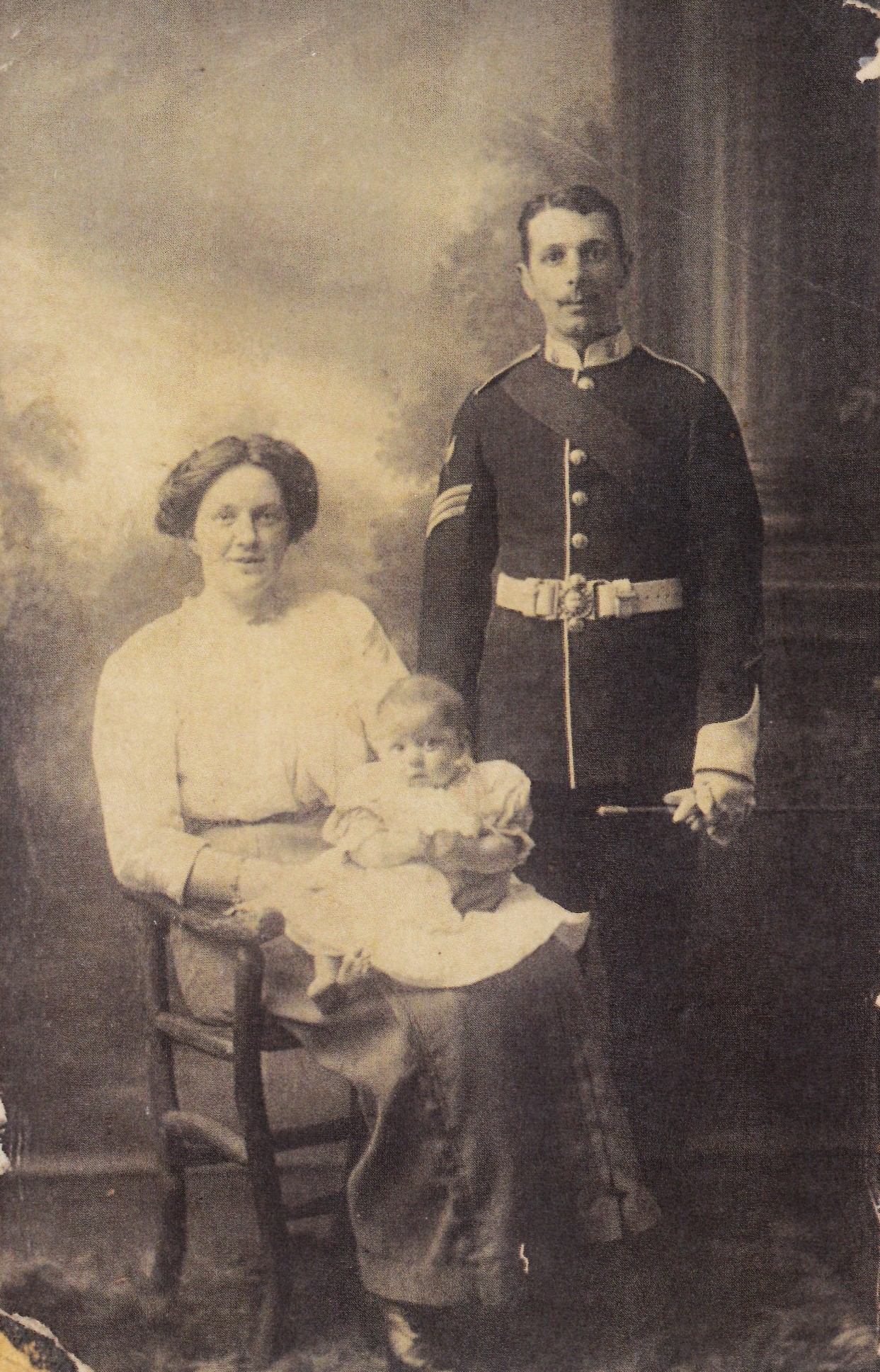
It was there that Lilian was to meet her first husband, Leonard V. Stanley, who was a soldier from Essex stationed in the Curragh Camp. They married on the 18th of December 1912 and went on to have a son.

Lilian, Leonard and baby Victor.
With the outbreak of the First World War, Leonard was sent with his regiment from the Curragh Camp to fight in Europe. He would never get to return to Brannockstown to his beloved Lilian and their young son. He died in the 46th Stationary Hospital, Etaples, France, on the 10th of June 1918. I have poignant telegrams from that time that were sent to my grandmother. The first telling her that her husband was dangerously ill and denying her permission to visit him, following a request to do so. Then a second one bringing her the news that she must have been dreading, telling her that Leonard had died. Of note in that telegram is a sentence telling her to ignore an earlier telegram sent to her that day giving permission to visit him. From that, I could see that she had kept trying to get to her husband’s side.
I was only three when my grandmother passed away, but stories of her kind heart, her passion for helping others, and her tenacious spirit have traversed the generations of my family. Indeed it was, I would think, her kind nature that led to her meeting my grandfather.
Following her husband’s death she visited wounded soldiers who were hospitalised in Dublin. Those visits brought her to the Hermitage Hospital in Lucan, where my grandfather James was being treated for severe shell shock, having been the only survivor of a group of soldiers pulled out of a collapsed trench. I would imagine that it was through their shared experiences that love blossomed and they married in the Church of the Nativity of the Blessed Virgin Mary, Chapelizod, Dublin, on the 2nd of November 1919. They resided first in Chapelizod before settling in Palmerstown where they went on to have a family of six children together.

Lilian and James
My grandfather never spoke of his time in the war. If a war film came on the television, he would walk quietly over to the television and turn it off. A small act that spoke volumes of the turmoil still within.
My grandparents’ story is one of contrasts: my grandfather being an Irish Catholic, my grandmother an English Protestant. Both experienced the trauma of war in different ways: my grandmother losing her husband who went to fight for his country, my grandfather severely shell-shocked from his time in the same war. Their common ground was trauma and grief. A love that emerged from that could overcome all else.
Leave a Reply