
Lucan has a fantastic array of Gothic Architecture which ranges from original medieval Gothic features through to the Early Gothic Revival period, the later Victorian Neo Gothic period, and beyond with lingering flourishes in the mid-20th century. Lucan’s gothic architecture can be found in a variety of settings from original medieval churches to Gothic Revival gates, lodges, walls, follies, outbuildings, and houses; all of which feature varying degrees of Gothic elements, some more adventurously than others.
This essay will endeavour to uncover Lucan’s Gothic architecture chronologically from its earliest beginnings in the 15th and 16th Centuries through to its later revival in the 18th century and beyond to the 20th century.
1. St. Finian’s Church, Esker.
The earliest features of St. Finian’s Church date back to the 12th Century, when it is believed to have been built on the site of a much older Christian cell church. The oldest architectural features include the narrow Romanesque window in the East gable, a small narrow window in the south wall, and a course of distinct herringbone blockwork found in the north wall.
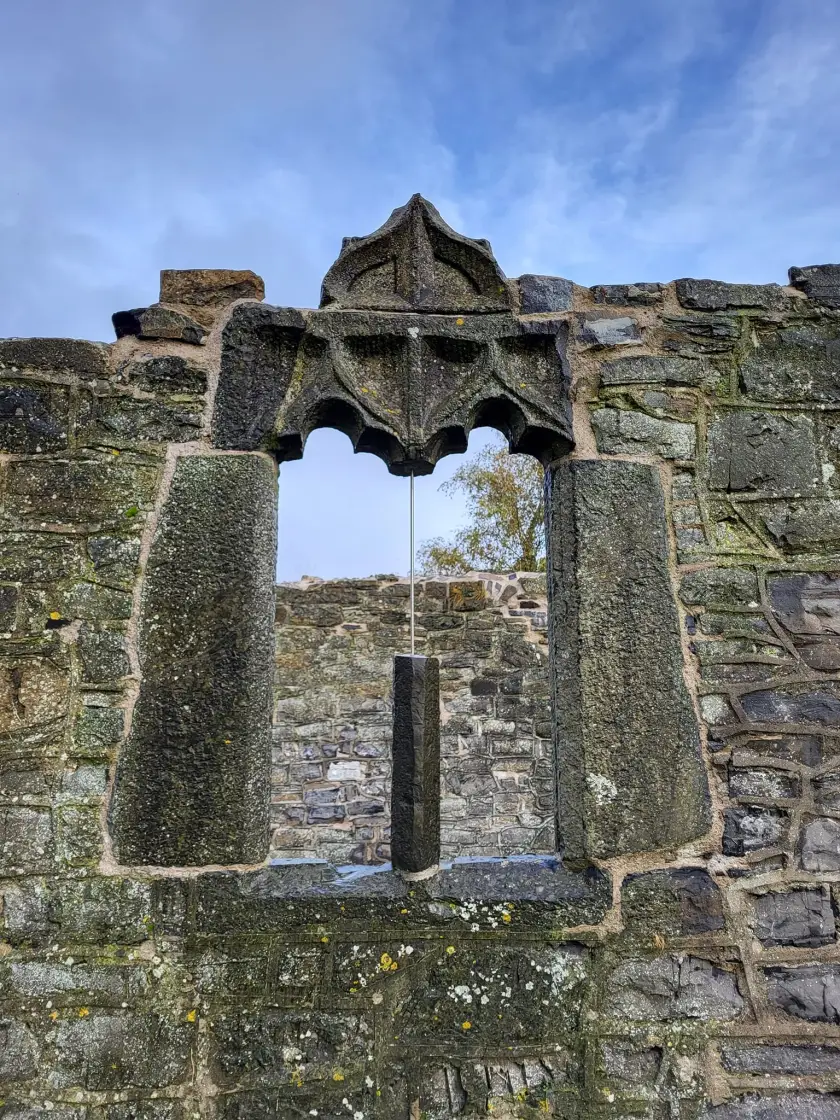
St. Finian’s Church underwent major redevelopment during the 15th and 16th Centuries, the most striking addition being the new bellcote and supporting buttresses to the west gable. During this period redevelopment the Church also had new Gothic windows added. Only two of these Gothic Architectural features remain on site; both are the remnants of double ogee window heads dating from around the 15th century. One of the two ogee window heads -at one point broken in two- was reset into an original window opening during conservation works. The partial remains of a second ogee window head were then placed inverted on top of the former during the same conservation works.
During the most recent conservation works carried out on St. Finian’s Church, a segment of an original window mullion was found and reinstated, using a metal rod to fix the segment in place pending the discovery of the missing mullion segments.
Unfortunately, there is no trace of the large tracery window that would have adorned the East gable. The entire Chancel end of the Church has been lost, with only the lower foundations remaining.
2. Church of the Blessed Virgin Mary, Lucan Village.
The Church of the Blessed Virgin Mary behind O’Neill’s Pub, in Lucan Village, dates from the 11th and 15th Centuries. The Church is strikingly similar in appearance and layout to St. Finian’s Church; except for having an adjoining priory tower house adjoining the chancel on the north-eastern corner. This tower would have housed the clergy, and hints at the importance of the site; something which is also reflected in the church’s proximity to the now demolished Lucan Castle.
As with St. Finian’s Church, the Church of the Blessed Virgin Mary underwent major renovations during the 15th and 16th centuries; with a strikingly similar buttressed bellcote and Gothic styled windows being added. The single remaining arch on the bellcote is noticeably a pointed Gothic arch.
The tall double ogee arch window located in the west gable, and framed by the bellcote buttresses, is the only fully intact in situ Gothic feature in Lucan. Partial remains of a double ogee arched window head can be found built into an infill section of the southern wall. This double ogee arch is unique from the rest, as it features carved abstract foliage, whereas the other two ogee arched window heads are purely geometric in design. When compared, the differences between all tree window heads suggest that the Gothic renovation of the Church and tower took place over various stages.
The third and final ogee arched window head can be found set into the wall over the concrete lintel of what is now the entrance to the priory tower (in the east wall of the tower); the original two-centre arch doorway into the tower from the interior north wall of the Church having been blocked up. A segment of the original window mullion has been repurposed as a door jamb, supporting the concrete lintel. It is unclear exactly when the original tower doorway was blocked up and this new doorway created; it is possible that the concrete lintel was added later to reinforce the new and now only opening to the tower.
The large, now blocked-up, windows of the Chancel on the eastern end of the Church are original window opening that were altered in the 18th century, as is evident from the added brickwork surrounds. These windows would have once contained Gothic tracery, though no trace of their original tracery remains in situ.
There are two blocked-up doorways in the southern wall. The western most door, which would have granted access to the Nave, is a slightly pointed two-centre arch, made from random stone masonry. Put log holes around the door suggest that there may have been an external porch. Remarkably, it has been noted recently that the fire surround in the nearby bath house may be the re-purposed original Gothic doorway of this porch. A second doorway, half hidden by a vault built onto the side of the Church, appears to have a rough-cut Gothic arch surround. No trace of the original north doorway remains as the northern façade of the church from the west gable to the chancel walls is completely gone.
3. Adderig Church, Adderig.
Adderig Church is a small rectangular, ancient church. In a terrible state of ruin and until recently grossly overgrown with ivy, many of its architectural features have been lost or hidden. Though I have not been to the ruin since the ivy was removed, photographs seem to show that the south doorway may be Gothic in style, with a pointed two-centre arch.
From the late 1740’s, the predominance of Neoclassical design during the Age of Enlightenment and increasing industrialisation led to the emergence of the Early Gothic Revival and later Romanticism styles in England; this would quickly have spread to Ireland, as families like the Vesey’s of Lucan split their time between London and Dublin. Sometimes referred to as “Gothick”, early Gothic Revival was not always fully true to the original Gothic architectural style, instead using Gothic elements to embellish and add a sense of antiquity, or curiosity. The style would quickly grow in popularity during the late 18th Century and early 19th Century eventually superseding Neo Classical design to become the dominant architectural style of the western world.
4. The original gates to the grounds of Lucan Demesne, Leixlip Road.
The pillared and urn surmounted gateway to the grounds of Lucan House is symmetrically flanked by two pedestrian doorways set into a rough stone wall with a corbelled slate-capped parapet and two small, corbelled and slate roofed, quadrant lodges. The pillars and surrounds of the two Gothic pedestrian doorways are constructed from rough cut stone starts and naturally potholed river stone blocks. The keystone of each arch has a nick cut out of the bottom to emphasise the Gothic shape of the doorways. Both pedestrian archways feature timber doors with cast iron hinges on the interior side.
On the interior side of the gate, each of the quadrant lodges features a heavy-set doorway with potholed-stone start and block surrounds, and flat, neoclassical arches with large potholed keystones and voussoirs. The doorways of the small lodges, distinctly not Gothic, are flanked on either side by two small Gothic windows. The windows of the east lodge having been blocked up. This mismatch of “Gothick” and Neoclassical elements, and the choice of potholed limestone, emphasises the romantic ideal of creating a sense of rustic antiquity.
Originally, the gate and two small quadrant lodges stood alone in the boundary wall, as seen in the 1772 Scale map of Lucan. However, by the time of the 1830’s/40’s map of Lucan, a run of servant houses was constructed in line with the west lodge. The Gothic design of the original lodges was carried through in the first two windows of this new extension, which flank a new segmental arched doorway. These later Gothic styled windows are notably bigger than the windows of the original lodges. The segmental arch windows at the far west end of the extension appear to be purely utilitarian as they do not fit the Gothic or Romantic aesthetic of the original lodges, it is possible that they were deemed to be too far from the gate to invest in.
The Romantic Early Gothic Revival design of the original gate and lodges would have perfectly complimented the now demolished Lucan Castle, which Thomas Roberts painting of Lucan Demesne, now in the National Gallery of Ireland, shows to have had Early Gothic Revival windows added to both the original tower and the vast extension adjoining it. The gate and Castle would together have presented a very imposing albeit grim approach for visitors. Standing in stark contrast to the current Palladian styled Lucan House, the Romanticism and Early Gothic style of the original gate and lodges making them more unique and mysterious.
5. Gardenville House, Primrose Lane.
Located across the road from the original gate and quadrant lodges, on the corner of Primrose Lane, sits the charming Gardenville House. Once the residence of the Land Steward for Lucan Demesne, Gardenville commands a prominent location overlooking the comings and goings through the gate of the Demesne and into the adjoining the walled orchard of the estate. The house is typically Georgian in design, however closer inspection reveals otherwise. High up, over the Leixlip Road, the round-arched landing window, the only window to directly overlook the Demesne, is embellished with Gothic tracery; certainly, an Early Gothic Revival feature and a reference linking it to the Gothic styled gates across the road.
6. The Bath House, Lucan Demesne.
In the depths of the Demesne woodland behind Lucan House, a small, diverted stream runs out from under the Leixlip Road and into the large opening of an arched grotto at the base of the Demesne wall. The stream then runs through a modern concrete culvert under the trail by the boundary wall, cascades down a small ornamental waterfall, under a small footbridge, and onwards down to join the meandering River Liffey. Almost hidden beside this cascading stream is what at first appears to be a small, weatherworn, ancient Oratory, its bellcote shrouded with thick ivy overgrowth.
Approaching from the small bridge, one is faced almost immediately with an east-facing gable, constructed from the same rustic potholed limestone river rock used on the original gateway mentioned above. The gable is surmounted by a rough rendered pediment, framed with a border of the same potholed limestone. Inset within the rough render of the pediment are small pebbles and river stones that form Gothic quatrefoils; a heart-shaped arrangement of pebbles forms the centre piece of the pediment.
Centred in the gable is a gated Gothic doorway, heavily framed with potholed starts and blocks with a slightly protruding keystone. The doorway grants access to an airy, barrel-vaulted nave like room. Featured within are a mix of Gothic and classical elements. On the left (south) wall an original Gothic doorway from the Church of the Blessed Virgin Mary has been re-purposed as a fire surround. This is flanked on either side by large rectangular niches. On the right (north wall), an oversized, gated Romanesque archway floods the room with natural light. Directly in front a Gothic doorway, flanked by two oval wall niches, leads into a smaller dark “chancel” room where the through purpose of the building is revealed. Through the interior Gothic arch, one passes between the two thick internal buttresses that support the external bellcote. Filling the interior room is a small neoclassical shaped pool. The “chancel”, lit by three barred Gothic window openings is in fact a spa bath: the outer “nave”, with its large fireplace and large open archway mostly likely a drying room.
Further evidence of the Bath House being a Romantic Gothic Revival building rather than a religious building can be gleaned by the orientation of the building itself. The Bath House is positioned with the small “chancel” bathing room facing to the west. Traditionally, in Christian churches the Chancel would face east, towards the rising sun. The Bath House on the grounds of Lucan House is more likely orientated facing west to accommodate approach from Lucan House.
The Bath House and matching nearby original gates are likely to be very early examples of Early Gothic Revival and Romanticism architecture.
7. The new gate lodge of Lucan House.
The only other remaining early Gothic Revival architectural feature on the grounds of Lucan House can be found in the “New” gate lodge, just inside the principal gateway on Main Street. The new Georgian gateway on Main Street was created to complement the new Palladian styled Lucan House and create a new, far grander approach to the house than via the original Gothic Revival gateway mentioned above. Accompanying the new gateway was a new, larger gate lodge. The lodge features Gothic arched windows throughout, a common trait within the Gothic Revival period and a nod to the Gothic style of the older and far smaller quadrant lodges flanking the old Gate.
8. St. Catherine’s Chapel, St. Catherine’s Park.
Another fine example of an early Gothic Revival building with an inset original medieval Gothic feature. (Since writing the original Facebook post, it has been noted, by Don Cromer, that the foundation of the building could be of Norman origan, due to its squinched corners).
St. Catherine’s Chapel was constructed in either the late 18th or early 19th Century as a Chapel for workers of St. Catherine’s. Once neglected, with the interior open to antisocial behaviour, the chapel was recently the subject of a very successful conservation project. The ruins feature evidence of previous openings having been blocked up, built over, or altered. The footprint of the building is rectangular, though the 25-Inch map shows it to be “L” shaped in plan. From the evidence of overlapping features, the building may have been enhanced to become a feature, to match the nearby castellated gateway.
The present window openings on the south facade of the Chapel are Gothic in shape; though the use of brickwork in their surrounds and the fact that one opening overlaps with an older, blocked-up, flat arched doorway, points towards Gothic revival alterations rather than original Gothic. A thick band of brickwork can also be seen just above the pointed Gothic arches, hinting that the features above this point were added during the Gothic Revival renovations. The height of the structure was increased, and decorative crenulations added to the west and east gables.
The window of the East gable, however, is not Gothic Revival, but a fine example of an original medieval tracery window having been inset into the building. The origins of the original window are unknown to me. The original Gothic tracery window was set into the gable over an existing opening that was partially blocked up. The brick surround of the previous window is still evident under the added tracery window.
The west gable features a small four-centre-arch doorway in a section of wall that looks to have once had a porch. This style of arch, often called a “Tudor style” arch, originated during the Gothic period, though it did not see widespread use until the later Tudor period, hence the moniker.
9. St. Catherine’s gate and lodge, St. Catherine’s Park.
Situated nearby St. Catherine’s Chapel is a “castellated” gateway and lodge, designed by the architect, Francis Johnston, and dating from between 1780 and 1820. An enclosed yard is accessed via an impressive castellated, four-centre-arch gateway of finely cut stone, with small castellated towers and blind arrow slits. The flanking walls, which enclose the front of the lower yard, are made from rough rubble stone, and surmounted with crenulations. The yard walls feature decorative brick Cross arrow slits either side of the main gate and includes a small four-centre-arch postern doorway to the east of the gate. The adjoining lodge features window openings with similar brick framed, pointed arches and brick crenulations on the south gable. The wall along Black Avenue (the border between Lucan and Leixlip) also features a blocked-up four-centre-arch gateway, with an even more recently blocked-up doorway viable within this again.
This lodge was the birthplace, and later construction yard, of James O’Neill, a veteran of the 1916 Rising G.P.O. garrison and later Commandant of the Irish Citizen Army.
The main ruin of the upper yard, at the far end of Black Avenue, also features crenulated gables. The remaining architectural features on the buildings of the upper yard appear to be Georgian.
Unfortunately, access to both the lower and upper yards is not permitted. Both yards are fenced off and in great need of care after years of neglect. If ever conserved and opened to the public, they would be a fantastic amenity to explore.
10. Primrose Hill House (The Manse) Out building, Primrose Hill.
Dating from the late 18th century, this Early Gothic Revival outbuilding is at odds with the Georgian styled house that it complements. As is the case with several of Lucan’s Early Gothic Revival period buildings, Primrose Hill House has a connection with the famous English architect, James Gandon. The small outbuilding, most likely a coach House, is a romantic Gothic Revival building, set within the idealistic gardens for which Primrose Hill House is renowned.
The outbuilding features a four-centre-arch doorway with an overhead drip moulding within a crenulated gable. A stylised blind cross slit motif with overhead drip moulding adorns the centre of the corbelled pediment. The crenulated parapet of the gable is flanked by corner posts with pointed finals, features which appear on all the Early Gothic Revival period buildings with a connection to Gandon. Each of the two corner finals also features blind arrow slits.
To the rere of the outbuilding, a later glass lean-to adjoins the outbuilding. The lean-to features a more modern Gothic inspired window. There is also a free-standing Gothic arch gateway to the side of the outbuilding; it is likely this feature was also added later.
11. Lucan Demesne Orchard.
Once the walled garden for Lucan House, the Orchard housing estate retains many key features that link it to its prior use. Chiefly its high perimeter wall and the remains of the old tunnel that ran under the Leixlip Road, which connected it to the main grounds of the Demesne. There are also two remaining Early Gothic Revival elements remaining that are original to the site.
The first is located at the top of Primrose Hill, just inside the gates of Lucan Centre, at what would have been the extreme rere of the Demesne Orchard. Both the 6-inch map from the 1840s and the later 25-inch map show a small building linked to the Orchard at this point. It is impossible to say exactly what purpose this building may have had, as all that remains is an old blocked up Early Gothic Revival window opening with a brick surround. It is possible this may have been a small lodge or folly, as both maps show a water feature or reservoir that runs into a stream at this location also. There is still a small blocked-up culvert visible in the old Orchard wall on Primrose Lane that corresponds with where this stream would have intersected the Lane.
The second Early Gothic Revival feature remaining on site is the workers’ bellcote, located on what is now a back wall of the Orchard estate. The 1772 Scale map of Lucan shows a small walled enclosure within the orchard where the bellcote is located. This area is still evident on the later 6-Inch and 25-inch maps.
Raised up from the supporting wall by a squat cut-stone base surmounted by a course of brickwork, the bellcote with its pointed pediment handsomely frames a single Gothic arch. Remarkably, the original bell and wheel still hang idlily within the bellcote.
12. Griffeen Lodge and Outbuilding, 12th Lock Road.
Dating from the late 18th century, Griffeen Lodge is a playful example of an Early Gothic Revival period building. Being a principal domestic dwelling, Griffeen Lodge is unique amongst Lucan’s other examples of Early Gothic Revival architecture, which are either follies, lodges, outbuildings, gateways, religious buildings, or small embellishments. As with the above-mentioned Primrose Hill House, Griffeen Lodge is often attributed to the architect James Gandon.
The house is square in plan with decorative octagonal corner posts surmounted with long pointed finals. The crenulated parapets hide two hipped roofs. The doorways, windows, and decorative features are a playful mix of Gothic inspired architecture.
The south facade features Bay windows at ground level. Centred between these two bays, at lintel height, sits a decorative motif of six Gothic quatrefoils. The first-floor features two large Georgian window openings, each comprising of two narrow timber trefoil cusped arched window segments flanking a wider central Gothic inspired tracery segment.
The east facade, which faces onto the Lock Road, features a wide central chimney stack, decorated with seven small trefoil cusped arches motifs. Two four-centre-arches with moulded surrounds symmetrically flank the chimney stack at ground level. The northern arch houses the principal bossed timber doorway to house, while the southern archway is blind, added purely for aesthetic balance. The leadlight windows of the first floor on the East facade are narrow rectangular openings with stylised single cusped timber arches.
Next to Griffeen lodge is a detached outbuilding, possibly a small coach House, which is also embellished in an Early Gothic Revival style. The outbuilding features a corbelled gable with a large four-centre-arch entrance, two blind cross slit motifs symmetrically flanking a narrow window opening. The gable is flanked on either side by plain corner posts and finals. A small, corbelled abutment to the west of the outbuilding contains a small two-centre-arch doorway. The facade of the outbuilding facing directly onto the road is plain with small unadorned rectangular window openings.
The outbuilding underwent major renovation works several years ago, tidying up the building exterior and converting it into a small dwelling. To facilitate this change of use, a new doorway onto the road outside was added. The original roof line was also altered with a new roof line being raised up higher, creating a modern shadow gap between the top of the original wall line and the bottom of the new roof.
13. Cooldrinagh Lane Arch.
The last of Lucan’s 18th Century Early Gothic Revival elements is a lone, and now blocked-up, Gothic arched doorway on the Leixlip end of Cooldrinagh Lane, just beside the Cooldrinagh Cottages. The small archway with its brick surround appears to have been rendered at one point.
The final stage of the Early Gothic Revival period in Lucan will make the transition from initial stages of 18th century Early Gothic Revival into the 19th century and later stage of Early Gothic Revival in Lucan.
By the early to mid-19th century, Gothic Revival was rapidly increasing in popularity, becoming one of the predominant western architectural styles. In the late 18th and early 19th Centuries Gothic architecture was studied with more diligence and context; no longer being confined to the embellishment outbuildings and follies. No other buildings highlight this better than churches, which showcase Gothic Revival at its best and most pure. Though, having said that, the local Lucanian examples of Early Gothic Revival churches are very refined in their use of Gothic architectural features.
14. St. Andrew’s Church of Ireland, Main Street.
St. Andrew’s Church was completed two centuries ago in the year 1823; as is evident from the date featured on the weathervane atop the church spire. St. Andrew’s is another example of a gothic revival building with strong links to the architect James Gandon. At the very least the church is built on land James Gandon donated for its construction. If not designed by Gandon, it was based on his designs; the spire and layout bearing a striking resemblance to Gandon’s Church of St. John the Baptist, in Coolbanagher. St. Andrew’s Church was completed just months before Grandon’s death in 1823.
Up close the towering Church is quite imposing, yet it’s setting far back from Main Streets counters this, allowing the Church to viewed comfortably. The Church is rectangular in plan with a pentagonal bow on the east facade (internally this is the focal point for the congregation), an apse on the south façade, and a transept on the west façade. The walls of the church are rendered and crenulated with pyramidal finals at the corners. The Gothic Revival openings set into the walls feature refined leadlight timber Y-tracery windows with drip moulding above. The window in the pentagonal projection on the east facade is an impressive stained glass centre piece.
The square tower is very imposing and appears to loom over the viewer when standing at its base. The tower houses the main entrance on the west face and features tall narrow Gothic windows at ground floor on the north and east faces. Above these are wider louvred openings that house the bell. At the top of the tower, on the north facade, is the 1875 Dent & Co. of London clock, from the same clock maker as the one found in “Big Ben”. The clock features a drip moulding above and is mirrored by similar roundels and drip mouldings on each facade. The tower is visually reinforced by corner post with blind arrow slits, corbel supported friezes, pyramidal finals, crenulations, and a towering finely cut octagonal ashlar spire, which is visible from most Lucan, and undoubtedly forms the architectural centre piece of the village.
To the west of the Church a modern parish centre has been built, extending out from the original west transept. The modern parish centre extends from the old church without detracting from its original aesthetic, with blue-grey metal cladding used to defuse the roofline with the sky on top, while being masked at ground level with a stone facing. Though it must be said that the tower also helps in drawing the eye away and from the extension. Unfortunately, it has been too long since I have been inside St. Andrew’s Church, though if memory serves the interior design classical rather than Gothic.
15. St. Andrew’s Lodge, Old School Lane/Watery Lane.
Completed in 1827, St. Andrew’s Lodge is a former Church of Ireland school house. The Gothic Revival features, though paired back, nicely reflect those found on St. Andrew’s Church across the road. It would be a typical plain late-Georgian building were it not for Gothic embellishment to the front south gable.
The squared front gable is symmetrically flanked by two single storey entrance porches. Each has a door which at first glance seems to have round arch, but on closer inspection are ever so slightly pointed. A central ground level gabled projection features Gothic Revival tracery set into a rectangular window opening. Above on the second floor another rectangular window opening appears to have had its original tracery replaced with modern window frames. The squared gable of the main building and both flanking porches are surmounted by a frieze of rendered Gothic arcade motifs. A raised central tablet with pyramidal finals features a roundel with the inscription “Lucan Parish School 1827”.
16. St. Mary’s Catholic Church, Chapel Hill.
Completed in 1840, St. Mary’s Church has undergone many drastic aesthetic and functional changes over the years. Originally a rectangular three bay gable ended church, it now features many later extensions giving an irregular footprint.
The west gable features what was once the principal entrance, a large doorway with a Gothic fanlight, set into the projected base of the bellcote. The doorway is flanked on either side by tall Gothic arch openings with Y-tracery windows and double stone pilasters at the outermost edges of the gable. The doorway and lower windows are surmounted by three larger windows, each of which features a cut stone surround and fine Y-tracery. The doorway and central window above both have drip mouldings. In the centre of the gable pediment is a plain circular roundel. Above this is the church bellcote, which despite its sympathetic Gothic design is not original to the church.
Indeed, the gable parapet has been completely changed since the church’s original construction in the 1830s, as is evident from a colourised photograph of the church taken circa 1900. Originally, the church featured a more imposing bellcote and crenulated parapet. The double pilasters on each side of the gable once extended up above the pitch of the roof and featured tall pyramidal finals. There also appears to have been pyramidal corner finals on the east gable as well.
The original bellcote, however, seems to have presented structural issues and was thus removed; with a later photograph showing a plain pointed gable with no bellcote, crenulations, or pointed finals. The bell was hung from a wooden frame constructed on the lawn beside the church. This seems to have been the case until the 1970s when the church underwent a major renovation and extension project to accommodate Lucan’s then exploding population. A modern bellcote was added. However, it was too modern; its design completely at odds with Church’s original aesthetic it was replaced with the current more sympathetic bellcote. St. Mary’s west gable and bellcote has now had four iterations to date.
The original church layout featured doors at the western end of both the north and south facades. There is also an old doorway at the Eastern end of the south facade. Both this doorway and the one at the western end of the north facade are no longer in use and have been re-purposed internally to house confession boxes. Each of the two side facades once featured three large Gothic arched windows with Y-tracery and drip mouldings; only those of the north facade overlooking the road now remain.
In the 1860s a convent was constructed to the east end of the church. Later, in the 1890s a single storey vestry was added to the north facade. This extension was executed in a simple Gothic style and features a large stained glass tracery window in its north gable and smaller pointed windows on the west facade. A more recent flat roof porch has since been added to the side of this extension. Though it tries to complement the Gothic features of adjoining vestry and church which Gothic styled windows and external font; it falls short of the mark due to the flat roof and squared doorways; though this is due to being located directly under one of the original windows and so not having much height to play with.
The south facade of the church has been completely changed due to the new concrete extension from the 1970s. All the original Gothic Revival windows on this side have been lost. This new extension has also necessitated the interior layout of the church to change. The original altar, as with most churches was located at the eastern end of the building. This is no longer the case in St. Mary’s, with a new modern altar being located centrally on the north wall. This has effectively turned the new extension into the Nave and the existing original Nave into transepts, completely changing the orientation and use of the church. The remains of the original altar, with its marble quatrefoil motifs, can still be found under the eastern stained-glass window. The original rendering on wall and decorative mouldings around the high niches have all been removed as have the original Gothic Revival pulpit and cast-iron quatrefoil and trefoil cusped arch railings. Modern grey brickwork now frames most of the internal architectural features -likely to try and match the tone of the masonry- except for the impressive Gothic archway that leads to the vestry on the north facade. The doorway and surrounding tracery windows set into this archway are a fine example of Gothic Revival carpentry, which would have matched beautifully with carved pulpit that faced it.
Due to the modern design and location of the new altar and tabernacle, the central window on the north facade is now “blind” and non-existent from the interior. From the exterior however, the central window remains in situ and shows no signs of having been blocked off internally. Finishing off the original Gothic Revival interior are impressively painted Stations of the Cross, each of which is framed within a gilded Gothic arch and mounted to the walls.
By the late Victorian period, with Gothic Revival at its height, architects and designers began to playfully execute their Gothic designs using modern industrial materials; namely with colourful, moulded bricks and wrought, or cast iron. The use of brickwork as a decorative feature became popular during the Victorian period thanks to the mechanisation of the manufacturing process allowing for shaper edges, more colour, and a greater range of moulded brickwork for innumerable array of surround, archway, and edge detailing.
Ultimately, the increased industrialisation that originally lead to the emergence of the Gothic Revival period would culminate with its peak in the 1880s and the rise of the Arts and crafts movement; a movement that rejected mass production, often recognised by its asymmetrical, Mock Tudor style, and attention to craftsmanship and structure. Lucan’s late Victorian Gothic churches rely heavily on Victorian brickwork to emphasise their minimal Gothic features.
17. Methodist Church, Village Green.
Traditionally, Methodist churches would have been plain, unadorned, and purely functional buildings. However, by the midmid-19th Century it was deemed appropriate for Methodist churches to be constructed in an unadorned Gothic Revival style. The Revd. Frederick Jobson, who proposed the adoption of the Gothic revival style “argued for beauty and perfection in design and execution without unnecessary adornment” (Source: Historic Methodist Architecture and its Protection, Ian Serjeant). This is certainly true of Lucan’s Methodist Church. Once housed in an unassuming building on The Square, just off Main Street, the Methodist congregation built its current place of worship around the year 1877.
The 25-inch 1890s map shows that the small Church was originally rectangular with a small porch located on the north facade, and a small pentagonal apse at the Church’s east end. The Church has since had a sizable lean-to extension added to the north facade. Viewing the west gable, this extension is quite sympathetic, being stepped back, with the joint masked by the new doorway and its contrasting overhead brickwork. The extension does not detract from the original gable profile; rather it seems to frame the original profile. However, from all other aspects, it falls very short of the mark with its unsympathetic plain rectangular window openings, and rough abutment to the east apse.
The original south facade is lined with four double lancet, leadlight windows; each with an attractive splayed orange brick surround, adding a nice pop of colour within the stone wall. The south facade hints at the detail that was likely lost during the extension of the north facade. At either end of the south façade a brick edged gable buttresses juts out, nicely framing the façade.
The pointed west gable is constructed from neatly cut stone with four string courses of vibrant orange brickwork. The same brick edges the buttresses, which coupled with the heavy stonework, aesthetically strengthen the gable giving this otherwise small building weight and a firm solid footing. Centred in the front gable is an attractive large Gothic three light window comprising of trefoil cusped arches and an overhead quatrefoil with orange brick surround. The geometry of the cut stone making up the window head is quite interesting. The west gable is surmounted by a decorative brick and limestone bellcote with “blind” Gothic arches in place of any actual opening for a bell. The design of the bellcote being enhanced by the vibrancy of the moulded brickwork.
The east gable with its pentagonal apse, is plain and unfortunately let down by the modern extension on the north façade which wraps around the back to join the apse on its north side. The squared openings, roller shuttered doorway and wire-mesh fencing on the extension windows detract from the charm of the rere of the building. Fortunately, the high boundary wall hides this. At the apex of the east gable, a vibrant Gothic brickwork motif mirrors the same brickwork design found in the front bellcote.
The slate roof is plain apart from alternating three-hole crested, vibrant orange, ornamental ridge tiles.
18. Presbyterian Church, Main Street.
Presbyterian Churches likewise began to favour the Gothic Revival architectural during the mid to late 19th Century, with the Lucan Presbyterian Church being built around the year 1880. The Church’s original west façade is composed of a pointed brown brick gable with a stepped base, which firmly grounds the building. Each of the two steps at the base of the wall are topped by a course of splayed orange brickwork. On top of the upper most step two dwarf columns with foliate capitals sit, flanking a central Gothic doorway. The columns support the orange moulded brickwork that forms the archway. The central doorway is flanked by two tall cusped lancet windows with orange brick arch heads.
A large four light gothic window comprising of trefoil cusped arches and an overhead quatrefoil fills the apex of the gable. Like the windows and door below the arch comprises of both moulded orange and dark grey brickwork. The west gable is lined throughout with alternating bands of both orange and grey brickwork, with a small grey brick roundel featuring in the top of the gable. A small stone trefoil cross stands above all and finishes the top of the pinnacle of the gable.
The 25-inch map from the 1890s shows that the church was originally a narrower building. It was also slightly shorter, featuring a small apse on the east gable. The south and north facades have both since been extended out, widening the internal Nave; most likely in 1988, when the church was subject to major alterations. From the front west facade these two side extensions are hardly noticeable as they are stepped back from the original gable and faced with glass, framing the original profile of the church. The north extension is easily viewed from Hanbury Lane, where the extension continues the pitch of the roof down past the original eaves line and features three gabled projections. Each projection has a modern Gothic styled window framed between the end buttresses. The materials used in the side extensions are very sympathetic to the brickwork used throughout the original front facade, though the bricks are noticeably more modern. The use of metal downpipes between the buttresses of the projected gables is a welcome touch.
The original eastern apse was removed, and the main body Church extended back in its place, joining the neighbouring building behind. This rere extension comes out in line with the two side extensions. The slate roof is plain with the only decoration being saw tooth ridge tiles.
19. Rectory doorway, junction of Main Street, the Lower Lucan Road, and bottom of Chapel Hill.
The Rectory or The Glebe as it was also known, was once a large Georgian styled building located on sprawling lands that ran down to the river Liffey. The small doorway, set into the corner of the boundary wall, dates from the late 19th century and can be seen on the 25-inch map. The doorway consists of a single ogee archway with single panels on either side and an ogee arch profile panel above.
20. Original St. Joseph’s Presentation Convent gateway, Chapel Hill.
Dating from the construction of the Convent adjoining the rere of St. Mary’s Catholic Church in the 1860s, the original gateway consists of a main carriage entrance flanked by two smaller gated pedestrian doorways. The gates are nice examples of Victorian cast iron metalwork featuring Gothic Revival quatrefoils. During major renovation works completed in 2022, a new wider gateway was added to better facilitate modern vehicular access. Fortunately, the original gateway was maintained, though the capping stones and staggered brickwork of the pillars were temporarily removed during the works, before being reinstated before completion.
21. Cast and wrought iron grave makers, “Old” New Esker Cemetery & St. Mary’s Church Graveyard.
Cast and wrought iron grave makers became hugely popular in the late Victorian period, mostly due to their affordability. Unfortunately, their longevity is not particularly great as they require maintenance to retain good order. Unfortunately, later generations could be tempted to discard rusted examples without realising their significance. Lucan’s “Old” New Esker Cemetery and St. Mary’s Catholic graveyard both have many fine albeit neglected and rusted examples of iron grave makers. These metal markers are often simple crosses. However, a few examples showcase Victorian ingenuity and metal workmanship at its finest. A few examples even nod towards Gothic Revival, featuring clearly medieval features and quatrefoil motifs.
22. Stone headstones, “Old” New Esker Cemetery & “New” New Esker Cemetery.
Indeed, it is in Lucan’s cemeteries that mainstream use of Gothic Revival features held its foothold longest, with Gothic inspired headstones being a common feature well into the 1950s and beyond. Outside of Lucan’s cemeteries however, the influence of the Gothic style in Lucan dwindled to limited use within ecclesiastical settings or in nods to past and lost features.
23. Leixlip Liffey Bridge.
The upriver parapet of the Lucan-Leixlip Liffey Bridge features modern metal railings with Gothic arch motifs showcasing handsomely painted leaping Salmon of Leixlip. A nice example of a nod to the past, the Gothic motifs on the bridge take on a greater significance when one considers that a now demolished Lodge abutting the Lucan end of the bridge featured Early Gothic Revival window openings.
24. St. Patrick’s Church Esker.
After having seen widespread use across all manner of buildings between the late 18th and 19th centuries, Gothic Revival design seems to have firmly settled back into its association with religious settings. One of the most recent examples of Gothic inspired design in Lucan can be found in St. Patrick’s Church, Esker. The church is a modern building constructed of exposed brick, block, and steel. Despite its modern design, however, the strong links established between Gothic features and religion have prevailed even here, with the beautiful bas-relief Stations of the Cross, framed within Gothic two-centre-arches. This Gothic influence aside there is a more important medieval feature hidden in plain sight. The carved Rood figure of Christ on the cross.
This essay only highlights the existing Gothic features of Lucan. There are many examples known to have been lost; Lucan Castle, Polly Behan’s Shop, Woodville House Lodge, and the lodge At the Lucan-Leixlip Liffey Bridge to name but a few. The remaining builds highlight the long expensive legacy that the Gothic period has had. Not bad for a style with was originally named derisively for its break with classical aesthetics.
Leave a Reply