
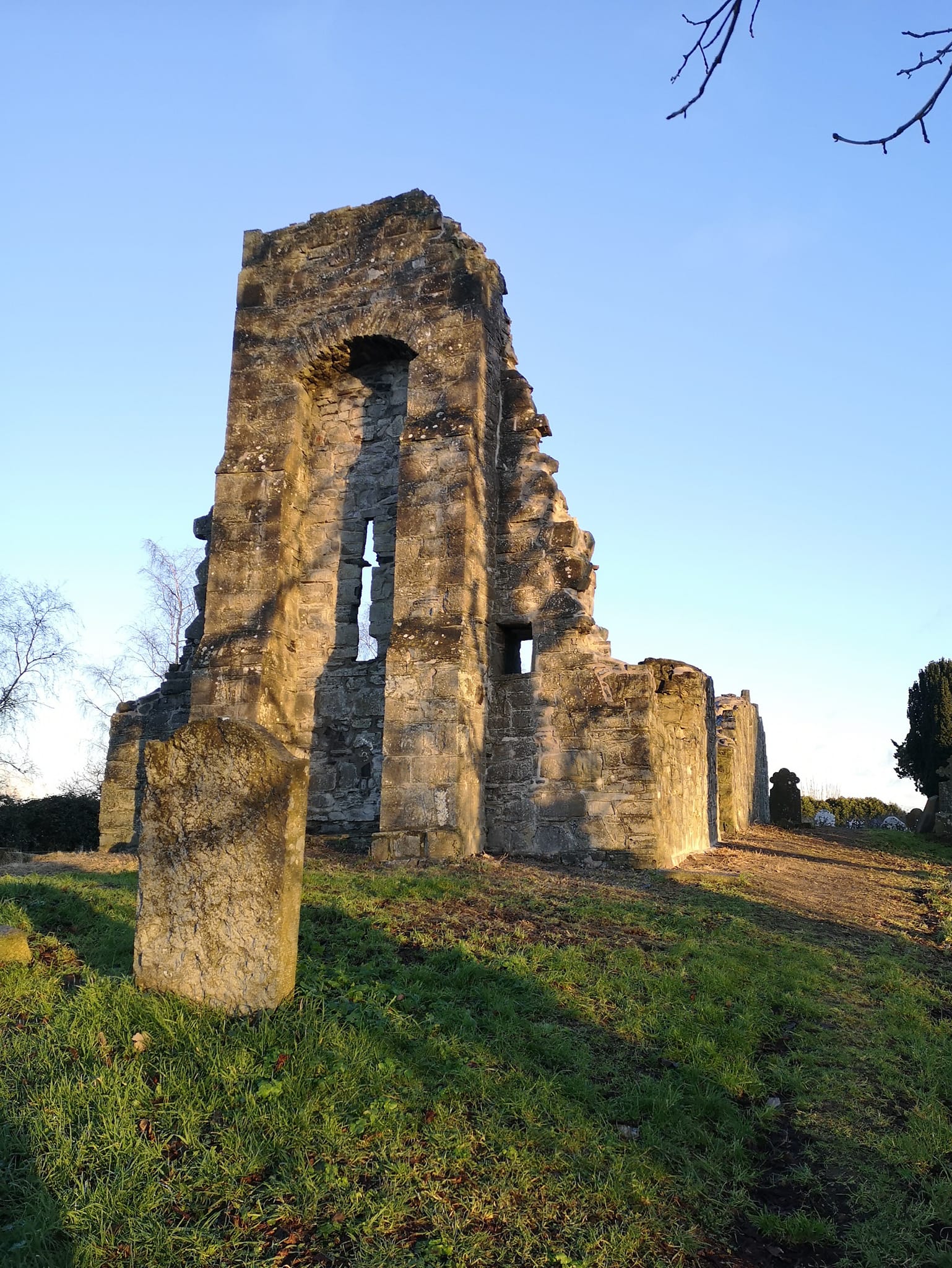
Over the course of the coming days I will highlight many of Lucans Gothic-style architectural features.
The posts will highlight local architectural features from some of the distinctly different periods of Gothic Architecture – Original Gothic, Romanticism & early Gothic Revival, and Late Gothic Revival. Lucan has many fine examples from all periods.
This first post will highlight the remnants of Lucan’s original Gothic architectural features, most of which is to be found in the walls of Lucan’s Medieval churches.

1. St. Finian’s Church Esker.
St. Finian’s Church dates from the 12th Century, and is believed to have been built on the site of a much older Christian cell church. The oldest architectural features include the narrow window in the Eastern gable, a small narrow window located in the southern wall, and a course of herringbone patterned blockwork in the north wall.
St. Finian’s Church underwent major redevelopment in the 15th and 16th Centuries with the addition of a new bellcote and supporting double buttress on the west gable. During this period the Church also had new Gothic style windows added. Only two of these Gothic Architectural features remain on site; both are the remnants of double ogee arch window heads dating from around the 15th century.

One of the two window heads -at one point broken in two- was reset into an original window opening during conservation works. The partial remains of a second window head were then placed inverted on top during the same conservation works.
During the recent conservation works carried out a few years ago, a segment of the original window mullion was reinstated with a metal rod, pending the discovery of the missing mullion segments. [Editor’s note: this reinstatement was paid for by fundraised monies from supporters of SOL through the innovative annual photographic calendar, organised by Paul Butler, SOL, with photos donated by SOL followers]

There is no trace of the large tracery window that would have overlooked the alter in the Eastern gable, as the entire Chancel at the Eastern end of the Church has been lost.

2. The Church of the Blessed Virgin Mary, Lucan Village.
The Church of the Blessed Virgin Mary, in Lucan Village, dates from the 11th and 15th centuries. The Church is strikingly similar in appearance to St. Finian’s; with the exception of having an adjoining priory tower house on the North-eastern corner. The tower would have housed the clergy, and hints at the importance of the site.

As with St. Finian’s, the Church of the Blessed Virgin Mary underwent major redevelopment during the 15th and 16th centuries; with a similar double buttressed bellcote and Gothic styled windows being added.

The tall double ogee arch window located in the west gable, and framed by the double buttresses, is the only fully intact in situ Gothic feature in Lucan. Partial remains of a double ogee arched window head can be found built into an infill section of the southern wall. This double ogee arch is unique from the rest, as it features carved abstract foliage, whereas the other two double ogee arched window heads are purely geometric in design. When compared, the differences between all three window heads suggest that the Gothic upgrade to the Church and Tower took place in various stages.

The last of the double ogee arched windows on site can be found overtly the lintel of what is now the entrance to the priory tower (on the east wall of the tower); the original two centre arch doorway into the tower from the interior the Church having been blocked up.

The large, now blocked up, windows of the Chancel on the Eastern end of the Church are original windows that were altered with brickwork in the 18th century. It is likely that these windows may have featured Gothic tracery, though no trace of their original tracery remains to be seen.

There are two blocked up doorways in the southern wall. The western most door, which would have granted access to the Nave, is a slightly pointed two centre arch, made from random stone masonry. Put log holes around the door suggest that there may have been an external porch. Remarkably, it has been noted recently that the fire surround in the nearby bath house may be the re-purposed original Gothic doorway to this porch. A second doorway, half hidden by a vault built onto the side of the Church appears to have a rough cut Gothic arch surround.


3. Adderig Church, Adderig.
Adderig Church is a small ancient church. Having fallen into a terrible state of ruin and until very recently having been grossly overgrown with ivy, many of its architectural features have been lost or hidden. Though I have not been to the ruin since the ivy was removed, photos seem to show that at least one of the doorways may be Gothic in style, with a pointed two centre arch.
Leave a Reply